Our Technology
Impulse Excitation Technique
A fast, accurate, and non-destructive method for measuring elastic properties of materials
What is IET?
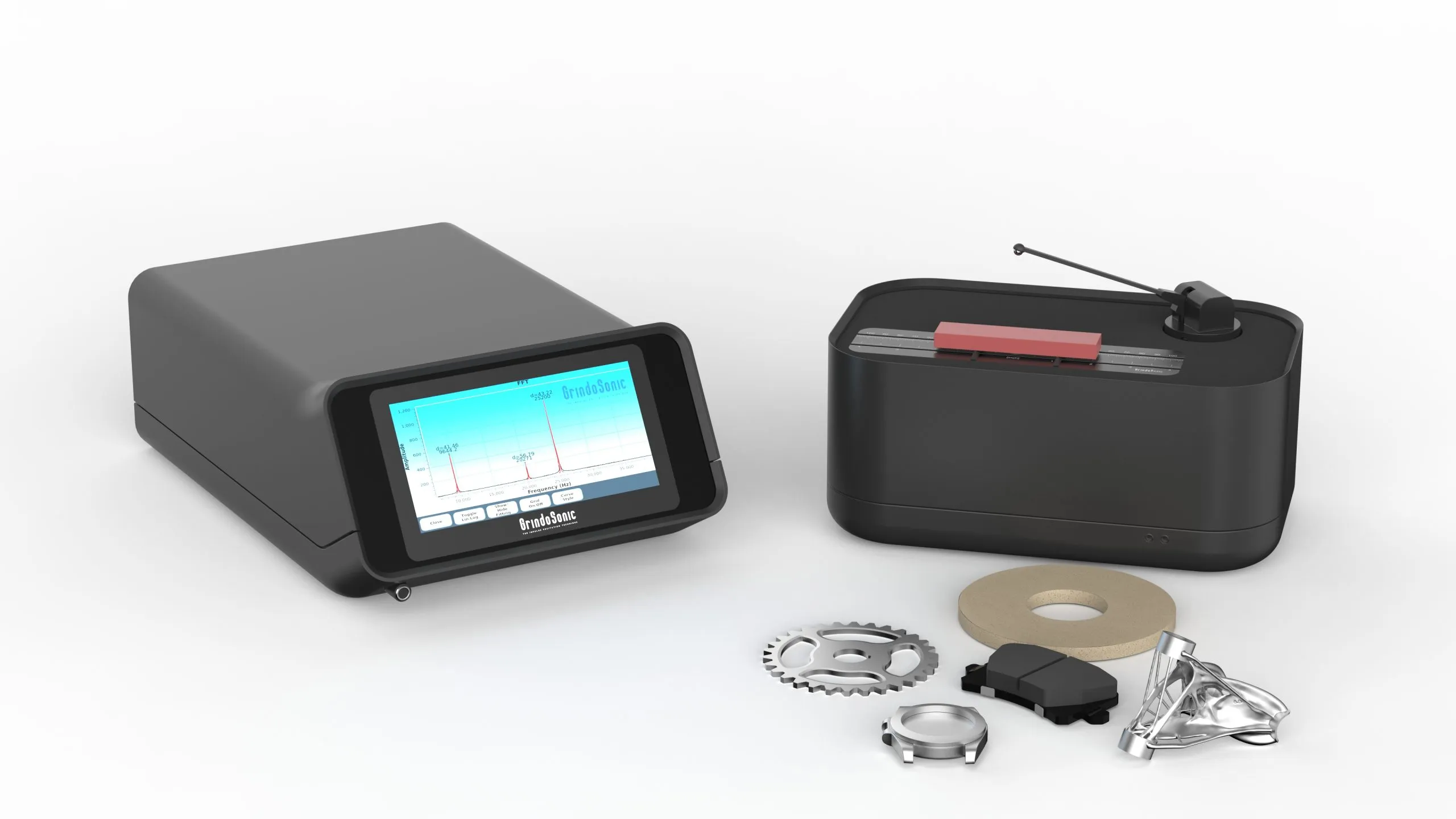
Impulse Excitation Technique (IET) is a non-destructive test method that measures the resonant frequencies of a material sample to determine its elastic properties.
A small mechanical impulse excites the sample's natural vibration modes. The resulting resonant signal is captured by a sensor, and the resonant frequencies are analyzed to calculate:
- Young's modulus (E) - material stiffness
- Shear modulus (G) - torsional stiffness
- Poisson's ratio (v) - lateral strain ratio
- Damping (Q-1) - internal friction
Simple Process
How It Works
Excite
A light tap excites the sample's natural vibration modes
Capture the Resonant Signal
A sensor records the resonant response with 0.1ppm resolution
Get Results Instantly
E, G, Poisson's ratio, and damping calculated in under one second
Compliance
Industry Standards
GrindoSonic systems comply with international standards for material testing
ASTM E1876
Dynamic Young's Modulus, Shear Modulus, and Poisson's Ratio by Impulse Excitation
ASTM E3397
Resonance Testing Using the Impulse Excitation Method
ASTM E111
Young's Modulus, Tangent Modulus, and Chord Modulus
ASTM C1259
Advanced Ceramics by Impulse Excitation of Vibration
ASTM C1198
Advanced Ceramics by Sonic Resonance
ASTM C1161
Flexural Strength of Advanced Ceramics
ASTM C1548
Refractory Materials by Impulse Excitation
ASTM C885
Young's Modulus of Refractory Shapes by Sonic Resonance
ASTM C215
Resonant Frequencies of Concrete Specimens
ASTM C623
Glass and Glass-Ceramics by Resonance
ASTM C747
Carbon and Graphite Materials by Sonic Resonance
ASTM C848
Ceramic Whitewares by Resonance
ISO 12680-1
Refractories - Dynamic Young's Modulus by Impulse Excitation
ISO 3312
Sintered Metal Materials and Hardmetals - Young Modulus
EN 843-2
Advanced Technical Ceramics - Young's Modulus, Shear Modulus, Poisson's Ratio
EN 14146
Natural Stone - Dynamic Modulus of Elasticity
SAE J2598
Automotive Disc Brake Pad Natural Frequency and Damping
GB/T 22315
Metallic Materials - Elastic Modulus and Poisson's Ratio
GB/T 8411.2
Ceramic and Glass Insulating Materials - Test Methods
GB/T 31544
High-Temperature Elastic Properties of Glass - Pulse Excitation
GB/T 34186
High-Temperature Dynamic Young's Modulus of Refractories
Why Choose IET
Advantages of IET
Fast
Measurement in seconds, not hours. Perfect for production QC.
Accurate
Frequency resolution better than 0.1 ppm. Highly repeatable results.
Non-Destructive
Test every part without damage. 100% inspection possible.
Cost-Effective
Low operating cost. No consumables. Minimal sample prep.
High Temperature
Measure at temperatures up to 1600°C with our HT systems.
Versatile
Works on metals, ceramics, composites, concrete, glass, and more.
Ready to Learn More?
Contact us for a demonstration or to discuss your specific application requirements.